
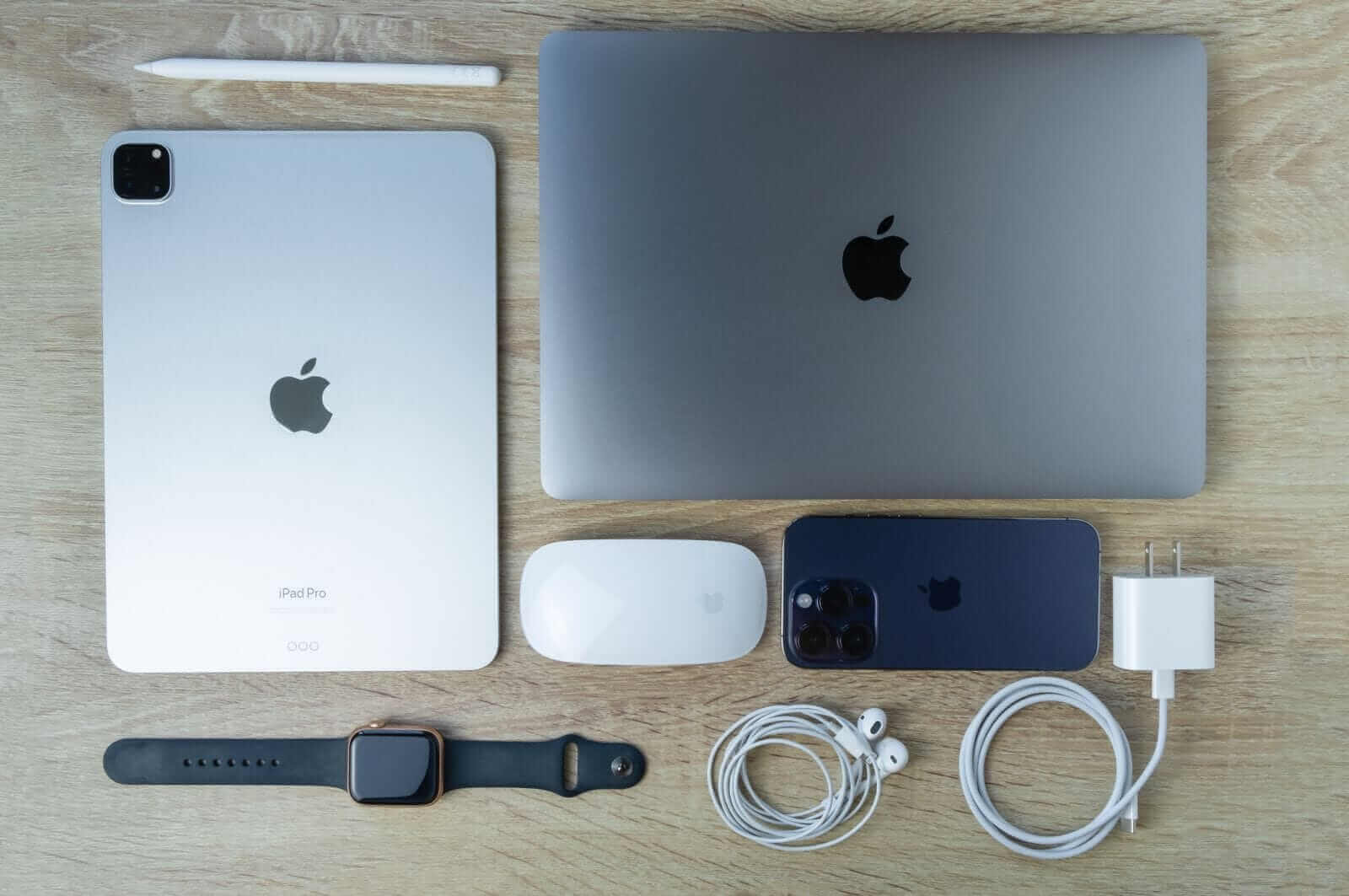
Apple products on the desktop by Ake Ngiamsanguan via iStock
Going into its fiscal fourth quarter results, which will be released after the close this Wednesday, October 30, it appears that after a prolonged period of negative headlines, the good times are back for Apple. Following a blockbuster response to its recently launched iPhone 17 lineup, the Cupertino-based global consumer technology giant briefly became the latest member of the $4 trillion market cap club, joining the likes of Microsoft (MSFT) and Nvidia (NVDA), as shares turned positive for the year. AAPL is now up 8% year to date.

www.barchart.com
However, questions remain about the company’s artificial intelligence (AI) strategy. While the rest of the “Magnificent Seven” – save Tesla (TSLA), to some extent – are making notable almost daily moves in disruptive technology, Apple’s strategy around AI remains relatively unsuccessful, following the somewhat botched launch of Apple Intelligence and the disappointing AI integration with Siri.
The fourth quarter impression therefore becomes even more crucial as the market awaits comments from CEO Tim Cook and the rest of Apple’s management on how the company is looking to build on strong iPhone 17 sales and what it is doing on the AI front, beyond the merely incremental.
Looking back at the third quarter
Make no mistake; Apple’s financials remain top-notch, marked by steady profits for years. The fiscal third quarter of 2025 was no different.
In the most recent quarter, the company reported net sales of $94.04 billion, up 9.6% from a year ago. Having an installed base of close to $2.35 billion and still growing revenue at 10% year over year on a base of close to $86 billion is quite extraordinary and an achievement that the company doesn’t get enough credit for. iPhone sales rose 13.4% in the same period to $44.58 billion, and the high-margin services segment grew 13.3% year-over-year to $27.4 billion.
Additionally, earnings of $1.57 per share represented year-over-year growth of 12.1%, although they were also above the consensus estimate of $1.44. Notably, Apple’s quarterly earnings have consistently surpassed Street expectations over the past two years.
However, as far as cash flows are concerned, there was a decline in cash generated from operating activities, although, at US$81.75 billion for the nine months ended June 30, 2025 (down from US$91.44 billion in the prior-year period), AAPL is hardly in a liquidity crisis. Overall, the company ended the quarter flush with cash at $36.3 billion, far more than its short-term debt levels of $19.27 billion.
For the fourth quarter, analysts expect Apple to report earnings of $1.73 per share, which would denote a year-over-year growth rate of 5.49% and revenue of $102.2 billion. The estimated revenue figure would mark an annual growth of 7.7%.
Let the good times roll (thanks to the iPhone 17)
The iPhone 17 has caused a sensation. Whether because of the new design or a refresh cycle, the newest model of Apple’s top revenue generator has been a success. According to a recent report from Counterpoint Research, the iPhone 17 lineup is ahead of the iPhone 16 in major markets like the US and China, with sales in the first 10 days rising about 14% in each region compared to last year’s launch window.
The series benefits from the energy-efficient A19 processor, which has taken battery performance and charging speeds to new levels. This translates to a larger physical battery that offers up to 30 hours of video streaming, along with 40W wired fast charging that reduces downtime. On top of that, features that were previously limited to the Pro models, like the 120Hz ProMotion display and Always-On functionality, are now standard, offering remarkably smooth scrolling, faster touch response, and an easy glance at notifications without reaching for the lock screen.
Demand is also getting a boost thanks to steady pricing on entry-level models, mirroring Apple’s approach with the launch of the MacBook Air M4 earlier this year, with no increases to scare away budget buyers.
Elsewhere, Apple is expanding its manufacturing bets as ties between the United States and China remain shaky, with India playing a central role. The company is ramping up iPhone 17 assembly there across the board and has shipped $7.5 billion in just four months, doubling the pace of last year’s total of $17 billion. This shift facilitates dependence on China just as tariffs loom. Even with a proposed 50% tax on Indian exports, Chief Executive Tim Cook’s ties to the administration have ensured a short-term exemption for key categories such as phones and laptops under the latest “reciprocal” trade rules. Simply put, then, iPhones made in India and shipped to the United States avoid the tariff impact, at least for the moment.
Apple’s AI strategy
With these positive currents growing around the iPhone, Apple has a real incentive to lean more into AI. Sure, the company started out a step behind the rest, but its strict stance on data privacy and personalized experiences has set the stage for a more polished second act. In that context, there’s a buzz around Veritas, an internal chatbot prototype designed by teams at Apple to perfect conversational AI, particularly for Siri updates.
From what is leaking, Veritas handles threaded dialogues, preserves chat history for contextualization, manages long exchanges and, in controlled tests, accesses user information such as emails, music libraries or photo albums to handle tasks such as editing images or modifying playlists directly within the applications. It’s experimenting with an internal architecture called Linwood, combining Apple’s own large language models (LLM) with select external models to speed things up while keeping privacy front and center.
Analyst opinion
Considering all this, sentiments around Apple may be about to become more optimistic. Sales of the iPhone 17 may be the most visible trigger for this. However, the company is making a lot of internal moves at a strategic and logistical level that could bode well for the long term.
With this in mind, analysts remain cautiously optimistic on AAPL stock, with an average rating of “Moderate Buy.” Of the 41 analysts covering the stock, 22 have a “Strong Buy” rating, two have a “Moderate Buy” rating, 14 have a “Hold” rating, one has a “Moderate Sell” rating, and two have a “Strong Sell” rating.
The average price target of $255.09 has already been surpassed, while the high price target of $315 denotes an upside potential of around 17% from current levels.

www.barchart.com
On the date of publication, Pathikrit Bose had no (either directly or indirectly) positions in any of the securities mentioned in this article. All information and data in this article are for informational purposes only. For more information, see Barchart’s Disclosure Policy here.
