
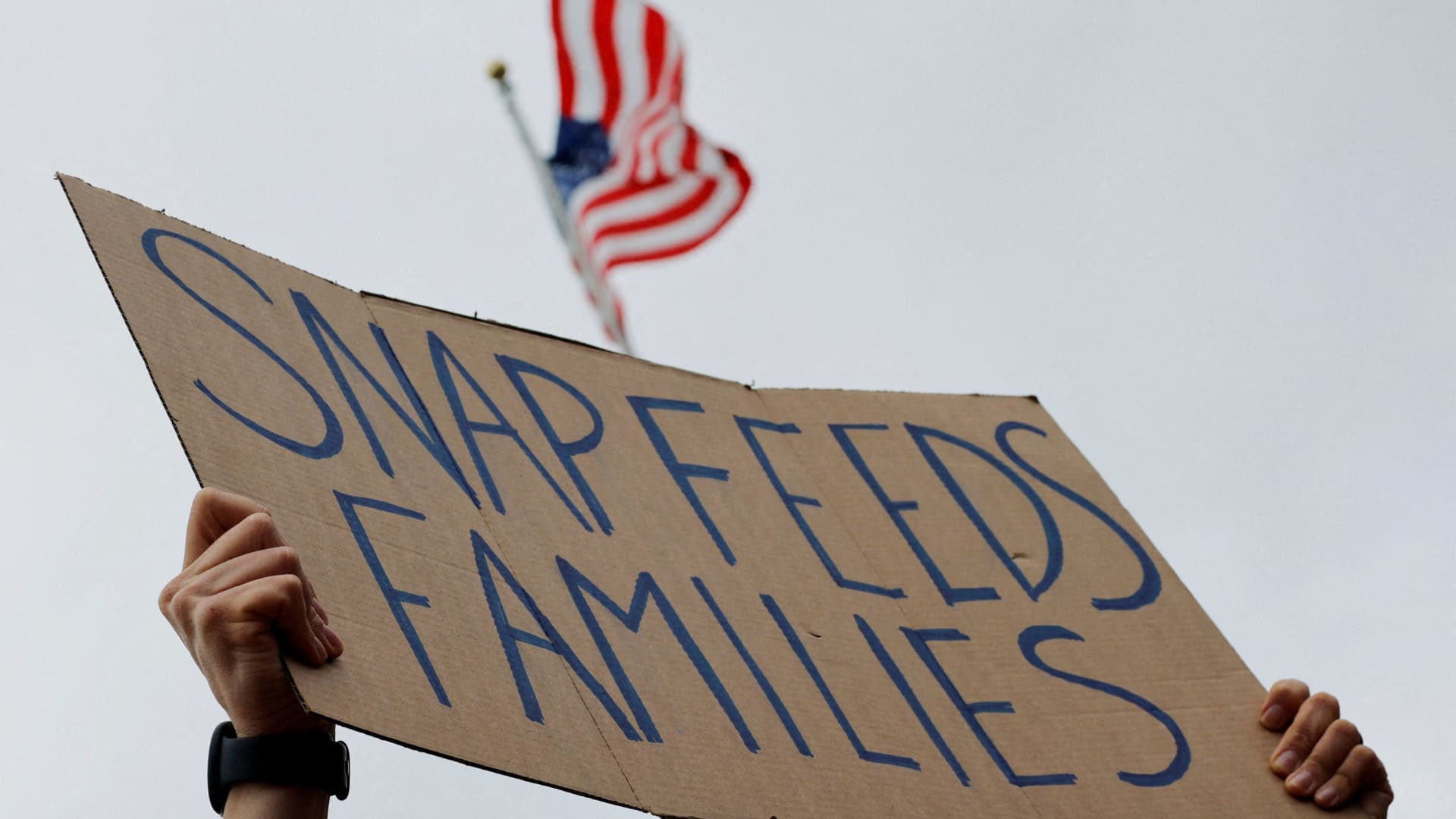
A man holds a sign that reads “SNAP Feeds Families,” as food aid benefits will be suspended starting Nov. 1 amid the ongoing U.S. government shutdown, during “A Rally for SNAP” on the steps of the Massachusetts Capitol in Boston, Massachusetts, U.S., Oct. 28, 2025.
Brian Snyder | Reuters
Nearly 42 million Americans are days away from losing their monthly food stamp check as the government shutdown enters its 28th day.
The Trump administration has said that funds for the Supplemental Nutrition Assistance Program, or SNAP, will not be distributed if the federal government continues to shut down on November 1. With little movement toward a resolution on Capitol Hill, Congress appears poised to beat that deadline.
Expiring aid would have a devastating effect on millions of households already struggling for food and would force people across the country to seek help from food banks. The drop in that spending would also have a domino effect on the economy, from small grocery stores to massive chains like Walmart and even retailers selling discretionary merchandise.
There will be “an immediate purchasing mix effect” toward lower profit margins on groceries and household staples, and the potential for more theft as grocery budgets are depleted, Wolfe Research analyst Spencer Hanus wrote in a note to investors on Monday. Consumer confidence among low-income Americans could also take a hit heading into the holiday season, Hanus said.
SNAP recipients received an average of about $187 per month in fiscal year 2024, according to government data. Among those beneficiaries, 73% live below the poverty line, which is currently $32,150 or less for a family of four.
After years of high food inflation and other recent hits to the size of government benefits, the loss of that assistance would be a blow to many low-income Americans.
Consumers who use SNAP benefits to pay for purchases spend more and shop more frequently than other shoppers, according to Numerator data.
On average, a SNAP recipient spends $832 per month on groceries, 20% more than a non-SNAP shopper, although the amount spent on each trip averages 12% less, or about $20.80 per outing, the market research company said. SNAP shoppers visit more retailers per month, 6.6, compared to 6.1 for people who don’t receive aid, according to Numerator.
Hanus said his company is seeing Google search interest increase for “food banks” and “food stamps” as SNAP recipients look for alternatives. While there is typically a spike in interest in those terms around Thanksgiving, he said “it’s increased materially year over year, which implies that this consumer is feeling a shock here.”
The potential loss of aid from the shutdown is the second recent blow to government food assistance programs for low-income Americans. The One Big Beautiful Act legislation passed by Republicans this year cuts SNAP benefits by about 20%.
Hanus estimates that the spending changes in the bill amount to a 1.5% to 2% impact on retail industry sales.
Retailers Most Relying on SNAP Benefit Spending
A person shops at a Dollar General store on May 28, 2025 in Chicago, Illinois.
Scott Olson | fake images
While there are different ways to consider how a disruption in SNAP benefits could affect retailers, grocery stores are likely to be affected. And the effects could hit employees.
“Grocery store staffing and inventory are often planned around profit cycles, so a lapse could result in reduced employee hours, losses of perishable foods, and decreased sales,” the industry group National Grocers Association said in a statement. “In addition, when benefits are restored, the resulting increase in demand could impact supply chains across the country.”
The numerator data shows Walmart, general dollar and dollar tree are more likely to serve SNAP shoppers, while Aim, costco and AmazonPrivately held Whole Foods are less likely. Hanus estimates that a high single-digit percentage of Walmart’s sales is related to SNAP, while Dollar General and Dollar Tree are in the mid-single digit range.
But SNAP users spend the most annually on groceries at Walmart, followed by kroger and Costco, according to Numerator.
Customers enter a Walmart store on April 9, 2025 in San Leandro, California.
Justin Sullivan | Getty Images News | fake images
Walmart is the country’s largest retailer and its largest grocery store. It also captures significantly more SNAP grocery spending than its competitors, Numerator found. More than 94% of SNAP shoppers shopped for groceries there last year, with an average annual spend of $2,653, or 26% of the cohort’s annual grocery spending.
Just under half, or 48.8%, of all SNAP recipients shopped at Kroger last year, spending an average of $1,687.67 a year, or 8.6% of the group’s total annual grocery spending.
While it requires a membership to shop, Costco ranks third for SNAP users purchasing groceries by average annual spending of $1,482.98. Walmart-owned membership club Sam’s Club ranks fourth in spend share at 3.8% and offers discounted memberships for new members who verify their participation in a government assistance plan.
Walmart referred CNBC to the National Retail Federation, which said cutting food aid funding “creates a crisis for millions of American families.” Albertsons referred CNBC to the Food Industry Association, which called on Congress to reopen the government and “ensure these vital programs remain reliable for those who must rely on them to get through a difficult time.”
Costco declined to comment. Kroger, Dollar General, Dollar Tree, Amazon and Whole Foods did not immediately respond to requests for comment.
In total, 3.6% of grocery store trips in the U.S. were paid for with SNAP or the government’s Women, Infants and Children benefits from 2025 through September, down from 3.9% in 2024, according to Numerator. That share has fallen from the pandemic peak of 6.5% in November 2021, when there was an additional emergency allocation.
However, more shopping trips are now funded with SNAP benefits than before the pandemic, when between 2.2% and 2.8% of food was purchased under the program in every month between February 2019 and February 2020.
The impact beyond groceries
If SNAP funds expire, recipients may also be able to purchase fewer other goods.
“Fewer dollars in consumers’ wallets forces a reallocation of discretionary dollars toward food and more tepid spending overall,” Wells Fargo equity analyst Edward Kelly said in a note to investors last week. He noted that retailers that reported profits in November can say they have seen weaker discretionary spending during that month due to the expiration of food assistance.
While there has never been a time when the federal government hasn’t come up with a contingency for SNAP funding during shutdowns, states are starting to step in. New York Governor Kathy Hochul is working on $30 million in aid for affected New Yorkers.
Additionally, lost SNAP benefits would need to be paid in arrears once the government reopens, although when that will be is unknown.
“We would expect an eventual resolution of the government shutdown, which could mean a windfall for low-end consumers in the peak shopping season as late payments recover,” Kelly said.
