
Pfizer Inc_ logo on iPad, by Koshiro K via Shutterstock
Founded 170 years ago and currently headquartered in New York, Pfizer Inc. (PFE) is a global biopharmaceutical powerhouse with a presence in more than 125 countries. Basically, Pfizer researches, develops, manufactures and markets medicines and vaccines across a broad spectrum: from oncology to immunology, internal medicine, rare diseases and preventive vaccines.
With a market capitalization of about $146 billion, Pfizer falls squarely in the “large cap” league, a category typically defined as companies worth around $10 billion or more. And while the post-pandemic drop in demand for COVID-19 products has challenged the company, the pharmaceutical giant is moving forward with a renewed lineup of innovative medicines and vaccines.
Its expanding portfolio shows a company that is not slowing down, but rather doubling down on delivering innovative treatments and expanding its impact on global healthcare. But despite the company’s strengths, its stock has struggled to capture investors’ attention.
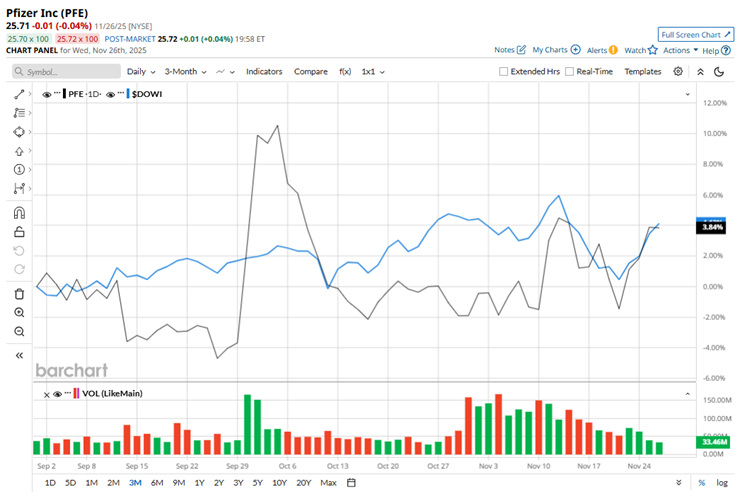
Over the past three months, PFE shares have risen about 3.2%, slightly lagging the 4.4% return of the Dow Jones Industrial Average ($DOWI) over the same period. After hitting a new 52-week high of $27.69, the pharmaceutical stock has fallen about 7.2% from that high.
www.barchart.com
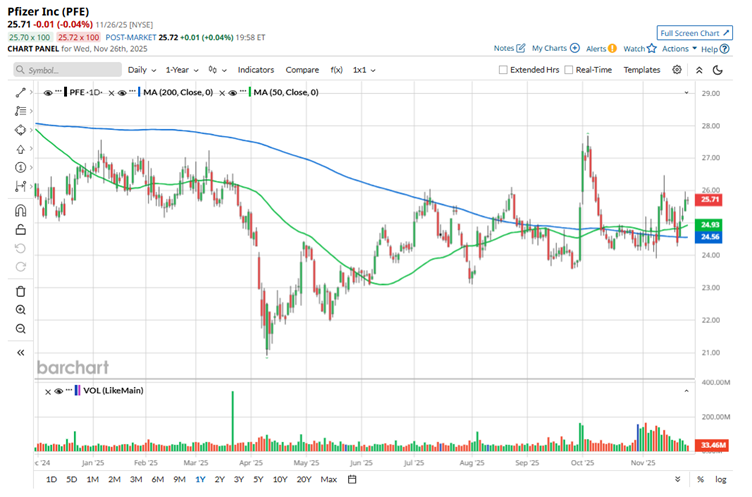
Things don’t look much better in the long term either. Over the past 12 months, Pfizer is only down slightly and in 2025 alone, the stock has fallen about 3.1%. Meanwhile, the Dow Jones Industrial Average has advanced rapidly, jumping roughly 5.7% over the past year and posting an impressive 11.5% gain so far in 2025.
On a more positive note, Pfizer stock has remained above its 50- and 200-day moving averages since the beginning of the month, a bullish sign that momentum could finally be shifting in the company’s favor.
www.barchart.com
Pfizer shares have been under pressure this year as investors worry about upcoming patent expirations for blockbuster drugs like Eliquis and Ibrance, a challenge that could impact future revenue. Compounding the problem, sales of COVID-19 products continue to decline. But there is finally a spark of good news. Shares rose nearly 2.6% on Nov. 21 after the FDA approved Pfizer’s PADCEV plus Keytruda combination for the treatment of certain bladder cancer patients.
Pfizer’s poor performance stands out even more compared to that of its rival Amgen Inc. (AMGN). While Pfizer has struggled to gain ground, Amgen has surged, rising 23.1% over the past year and an impressive 32.2% so far this year, leaving Pfizer far behind.
Although stock performance has been disappointing over the long term, Wall Street isn’t ready to write it off. The consensus rating from 23 analysts is a “Moderate Buy,” and with the average price target of $28.43, the stock still has around 10.6% upside potential from current levels.
On the date of publication, Anushka Mukherjee did not have (either directly or indirectly) positions in any of the securities mentioned in this article. All information and data in this article are for informational purposes only. For more information, see Barchart’s Disclosure Policy here.
