
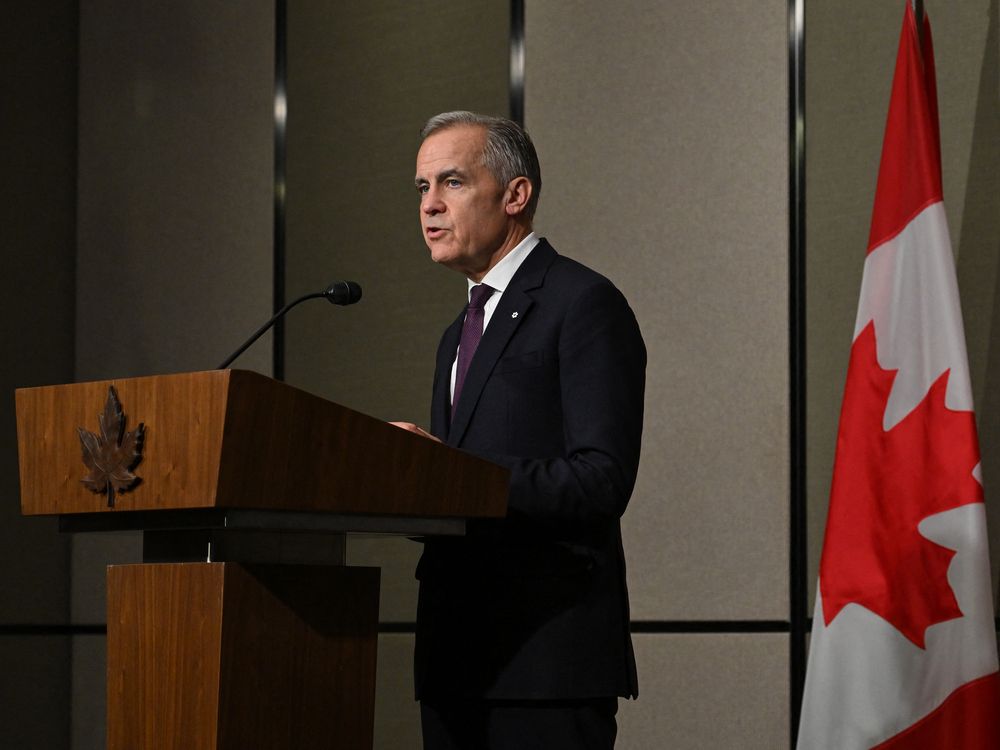
Earlier this month, Ottawa revealed details about what it calls its capital budget framework, a new approach to delivering the annual federal budget that aims to differentiate between operating and capital spending. First proposed during the election campaign as part of Prime Minister Mark Carney’s platform, the Liberals have argued that the new split budget process will give a more accurate picture of federal finances as the government focuses investment on the long-term growth of the Canadian economy. Critics and the opposition, however, have questioned whether the changes amount to fiscal sleight of hand. Ahead of the budget on November 4, the Financial Post’s Jordan Gowling looks at what we know about the new framework, how it is supposed to work and the controversy surrounding the measure.
What is Ottawa’s new budget framework?
Under the new budget, government spending and revenue will be divided into two categories, operational and capital. The main justification for the split is that capital spending and operating spending are fundamentally different: while operating spending runs out and repeats itself year after year, capital spending should help grow the economy and eventually generate a long-term return. Companies already make a similar distinction in their accounting, capitalizing and depreciating certain expenses. In theory, the government would be able to balance or even have a surplus on the operational side, and argue that it is operationally efficient, while running large deficits on the capital side. But the government has said the Nov. 4 budget will maintain the practice of including a headline figure for the deficit.
What constitutes capital expenditure?
According to Finance Canada, capital spending will include any government expenditure or tax “that contributes to public or private sector capital formation, held directly on the balance sheet of the government or on that of a private sector entity, an Indigenous community or another level of government.” Two main criteria will be used to make this determination: conditionality and clear linkage. Conditionality means that the recipient of the financing must invest in capital formation to receive the benefit, and a clear link means that the spending encourages or allows capital investment in “identifiable sectors or projects.” Finance Canada has listed a number of categories within capital spending, including capital transfers (which are transfers to other levels of government intended to be used for infrastructure or other productive assets), capital-focused corporate income tax incentives, federal debt amortization, direct financing or tax incentives for private sector research and development, measures that increase housing stock, and contractual agreements with proponents that lead to large-scale capital investments.
What constitutes operating expense?
Finance Canada has defined operating spending as transfers to individuals, social and health transfers, and costs associated with the daily running of government operations, such as salaries and benefits. The Public Accounts of Canada released for 2024 provide insight into the operational footprint of government spending, subtracting spending allocated to COVID-19 era programs. Transfers to other levels of government, including the Canada Health Transfer and the Canada Social Transfer, accounted for 19.2 per cent of government expenditures; major transfers to individuals accounted for 23.1 percent; and “other expenses,” which represent the operating expenses of 135 government departments, agencies and corporations, accounted for 26.9 percent of total government spending. This amounts to just under 70 percent of government spending.
Has anyone else tried this?
The United Kingdom currently practices a similar fiscal model of dividing capital spending from what it calls resource spending. Capital spending is defined as money spent on assets that last several years (i.e. buildings, vehicles) and resource spending is defined as money spent on things that run out (i.e. salaries). Notably, capital spending represents only five per cent of total government spending in the United Kingdom and has remained at roughly that level since 2005. Capital spending is expected to make up a much larger proportion of Ottawa’s budget. In a note, the Parliamentary Budget Office warned that the Canadian definition of capital spending was “overly expansive” and goes beyond the UK definition, with the inclusion of tax incentives, subsidies and measures that increase housing stock. More specifically, he said Ottawa’s definition risked including the “fiscal cost” of measures related to capital formation, not necessarily the actual amount of capital formation that would result.
Why is it controversial?
The new budget process has raised questions and raised concerns in several quarters. The PBO questioned the broadness of the definition of capital spending, warning that it would “likely overstate” the amount of spending that actually generates capital. There are also questions about how “clear linkage” will be assessed and presented in the capital budget and whether there will be restrictions on spending in this category. For example, Desjardins Group deputy chief economist Randall Bartlett has suggested that the government should provide assessments in future budgets showing how capital investments contributed directly or indirectly to economic growth and whether this exceeded the government’s borrowing cost. Conservative leader Pierre Poilievre has been more direct in criticizing the division, accusing the federal government of “cooking the books” for political advantage. The PBO also noted that it did not yet have a full picture of the changes and would “provide a deeper assessment when additional details are revealed.” Finance Minister François-Philippe Champagne has said the federal government plans to balance the operational part of the budget in three years, even if the overall deficit is expected to persist in the medium term.
• Email: jgowling@postmedia.com
Read more from our Red Ink series:
- How rising public debt could play a leading role in the next great financial crisis
- Danielle Smith: Balancing the budget becomes a lot easier if you build a pipeline
- Canada is part of a small club of countries with an AAA credit rating. How long can it last?
- We Owe Canada: Everything You Need to Know About Canada’s $1.28 Trillion Federal Debt (and Counting)
