

One Big Beautiful Bill (OBBB) recently approved the camera, and is now waiting for the Senate scrutiny.
Most analysts focused on the bill that accumulated more government expenses in existing deficits, but the most important part of the OBBB was in the background in the documents, specifically, in section 899.
Section 899 is the first step towards tariffs on money as a complement to the tariffs of goods.
So: What did the Trump administration include in section 899, the first step towards tariffs on money?
1) Which is -> Section 899 also known as “ Revenge Law Project ” imposes taxes on passive income (for example, dividends) derived from foreign property of the assets of the United States in countries that have promulgated ” unjust foreign taxes ” in the United States (read: tax services or corporate minimal taxes such as Canada, Europe and others);
2) Who is charged -> For a country to be subject to such taxes, it is sufficient for the Treasury Department to include them in a specific list of DFC discriminatory countries;
3) Applicable entities -> They include governments, individuals and corporations, almost all investors, including sovereign wealth funds and foreign central banks;
4) How high is the tax rate? Section 899 generally increases the current tax rates of the United States imposed in the entities applicable by 5% in the first year after promulgation, increased by an additional 5% for each later year, with the increases limited to 20% above the legal rate. This is the key: so that section 899 is applied, there must already be an applicable tax rate (before or after fiscal treaties) to increase.
5) When could you enter? Assuming that the OBBB is promulgated before October 2025, section 899 will enter into force according to January 1, 2026
It has been estimated that goods on goods bring approximately USD ~ 200/250 billion/year for the United States government.
The impact of a moderate money on money would also be potentially in the USD 100-150 billion/year.
But that requires a key change: the repeal of the exemption of interest of the portfolio (foot).
Foot exempts foreign investors incurring any tax retention when they buy treasures from the United StatesAnd section 899 only applies a surcharge tax to existing tax rates for foreign investors, which stands at zero for foreign property of the United States Treasury bonds.
Unless the exemption of interests of the portfolio (foot) is repealedSection 899 would only apply to dividends on the shares in the hands of foreign institutions, which contributes only a few $ millions/year to the Trump administration.
This clause in the Big Beautiful Bill clearly explains that (without a repeal of cake) section 899 would not apply to the “portfolio interest”, basically coupons in the treasure bonds held by foreigners:
In its current format, section 899 would send a worrying signal to foreign investors, but its immediate impact would be quite limited.
Foreign investors have shares worth $ 13 billion, but section 899 would apply a limited surcharge tax only on dividends and, therefore, cause limited damage. After all, investors have US shares for capital appreciation much more than to raise dividends.
But a repeal of foot would bring coupons of the Treasury under the tax regime of 30%, and after applying tax treaties, but superimposing the tax surcharges of section 899, we would be looking for a great impact.
The coupons derived from $ 15+ billion in the US Treasury. Owners abroad would incur total tax rates of 20%, but to get there, the Trump administration would have to repeal the cake: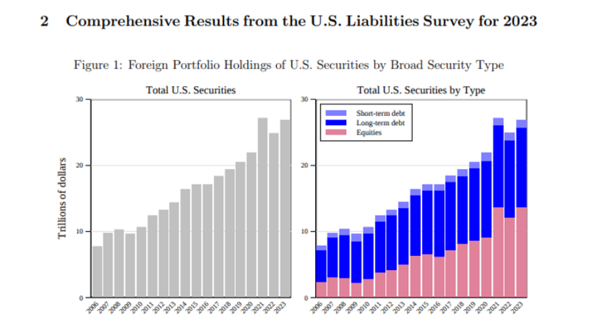
I cannot see any justification, including section 899 in Big Beautiful Bill to raise only 2-3 billion/year when dividends only in the shares.
If money tariffs must be part of the Trump Administration increased machine, they must go along with a repeal of the cake.
A potential plan could be seen like this:
1) Approve the great bill through the Senate possibly in July, but anyway before the August recess;
2) work in parallel in a portation of standing, sending a strong signal to “discriminatory countries”;
3) To calm the nerves of the bond market, accelerate the SLR reform to encourage US banks to buy treasure bonds
Besent has already indicated Q3 As the probable date to accelerate efforts behind the SLR reform, and such a timeline could be more than a mere coincidence.
From the point of view of the market impact, there are two paths ahead:
A) Section 899 without portation of cake: a marginally weaker
B) Section 899 + Deriance of cake: a great USD Down + Bond produces upward movement
Even without the repeal of cake, section 899 increases red flags among foreign institutional investors.
Using my dear reference of the Canadian pension fund, if you were the CIO or the Investment Committee in an allocation of more than 50%to the US assets. And you will see section 899 promulgated, what would you do?
At least its maturities of the United States will passively reinvest its USD material risk.
And if I saw concrete conversations about a repeal of exemption of portfolio interests that reaches the coupons of the treasures, what would you do?
This would be similar to “selective fed cuts” Just applying to you: a total tax rate of 20% in a treasure in the United States that pays a 5% coupon would be similar to a reduction of 100 bps in the interest rate earned.
Add a weakening of USD to the image, And he would have to hurry to cover his exposure to the USD along with considering national bonds or other bond markets (Europe?) As an alternative.
To conclude: While investors already had many reasons to be short in USD, they are now looking for 899 more reasons.
This was all for today, thanks for reading! Feel free to share this with a friend or colleague.
***
This article was originally published in Macro Compass. Join this vibrant Macro Investor Community, Assets of Assets and Coverage Funds; See what subscription level it suits you most using this link.
!function(f,b,e,v,n,t,s){if(f.fbq)return;n=f.fbq=function(){n.callMethod? n.callMethod.apply(n,arguments):n.queue.push(arguments)};if(!f._fbq)f._fbq=n;n.push=n;n.loaded=!0;n.version=’2.0′;n.queue=[];t=b.createElement(e);t.async=!0;t.src=v;s=b.getElementsByTagName(e)[0];s.parentNode.insertBefore(t,s)}(window, document,’script’,’
Source Link
