

It’s one of those revelations that, once you see it, you can’t unsee it. Basically, 99% of the content in the financial publishing space wouldn’t technically be considered analytics. Instead, within the scientific community, they would be considered opinions wrapped in the language of accounting principles.
Surely, no methodology that involves forecasting the unknown future can be considered factual. However, the central problem with financial analysis (whether fundamental or technical) is that practitioners are inferring patterns and sequences within locally random noise.
in the book Superprediction: The Art and Science of PredictionAuthors Philip E. Tetlock and Dan Gardner stated that it is easy for humans to misinterpret randomness, particularly because we lack inherent intuition for doing so. Citing the work of psychologist Ellen Langer, the seminal study showed that even the most intelligent individuals (in this case Yale students) could be fooled into believing they could skillfully predict coin tosses.
To truly understand market behavior, we can’t simply look at a company’s singular journey (whether that journey involves income statements or stock prices) over time. Instead, we should frame the price action as a series of tests. At sufficient frequencies, certain patterns and densities will invariably appear.
Furthermore, by using Kolmogorov-Markov frameworks overlaid with kernel density estimates (KM-KDE), we can measure probability densities, not only of the baseline condition but also under specific stimuli, whether cumulative or distributive. Any variation in density can be used to extract compelling business ideas.
The reason I claim that 99% of finpub material is not analytical is that the concept of KDE is practically non-existent. However, KDE provides the topography necessary to make visual sense of cyclic and stochastic environments.
To be frank, not using KDE for trading (especially options trading) amounts to bad practice. You’re already at a disadvantage on Wall Street. Here’s how to get at least some of the power back.
Novo Nordisk (NVO)
Novo Nordisk (NVO), down nearly 45% so far this year, has attracted some finpub articles claiming pricing errors or serious undervaluation. However, the question everyone should start shouting at the top of their lungs is: BASED ON WHAT!? Often the answer comes down to the author’s assumption about the path of earnings, cash flows, and the weighted average cost of capital.
Change the assumption, change the perspective. Since everyone has their own idea of what WACC or any other metric should be, fundamental analysis is entirely up to the author. Unfortunately, it is quite useless, especially when trading options.
I am not suggesting that quantitative analysis is infallible because it is not. I aim to keep the failure rate around 35%, but that also means there is significant risk in trading. No system can eliminate risk, but at least we can better understand how this risk is distributed.
Using a custom algorithm running a KM-KDE framework, we can arrange the 10-week returns for NVO stock as a distributional curve, with results ranging from $47.40 to $49 (assuming an anchor price of $47.63, Friday’s close). Furthermore, the price grouping would likely be predominant at $48.35.
However, NVO stock is currently structured in a 3-7-D formation; That is, in the last 10 weeks, it recorded three weeks up, seven weeks down, with an overall downward slope. Under this sequence, a price cluster would be expected to occur at $50.50.
Using data from Premier Bar ChartWe then choose the vertical spread that best aligns with the risk-reward profile in question. Some might consider the 45/50 Bullish Call Spread will expire on January 16, 2026, as the return strike should fall right where the density distribution is thickest.
SoFi Technologies (SOFI)
Financial technology (fintech) giant SoFi Technologies (SOFI) has enjoyed the opposite momentum from Novo Nordisk, with shares gaining roughly 64%. However, recent results have not favored SOFI stock. In the last month, for example, the value fell more than 7%. Last week was difficult as SOFI lost 9%. Still, a comeback could be in the works.
Again, using a custom algorithm running a KM-KDE framework, the average 10-week returns for SOFI stock would be expected to range between $23 and $26.50 (assuming an anchor price of $25.19). Furthermore, price clustering may be more predominant at $24.80, indicating a negative bias.
The evaluation above aggregates all sequences since SoFi’s debut on the public market. However, we are interested in one specific signal, which is the 3-7-D: three weeks up, seven weeks down, with an overall downward slope. Based on this sequence, the 10-week forward yields would likely range between $24.50 and $27.70. Most importantly, the price grouping would likely be predominant at $26.
The 25/26 bullish spread expiring on January 16 could be taken, leading to a very strong maximum payout of 92.31% if SOFI stock triggers the strike back. This is a very reasonable proposal given the expected density dynamics.
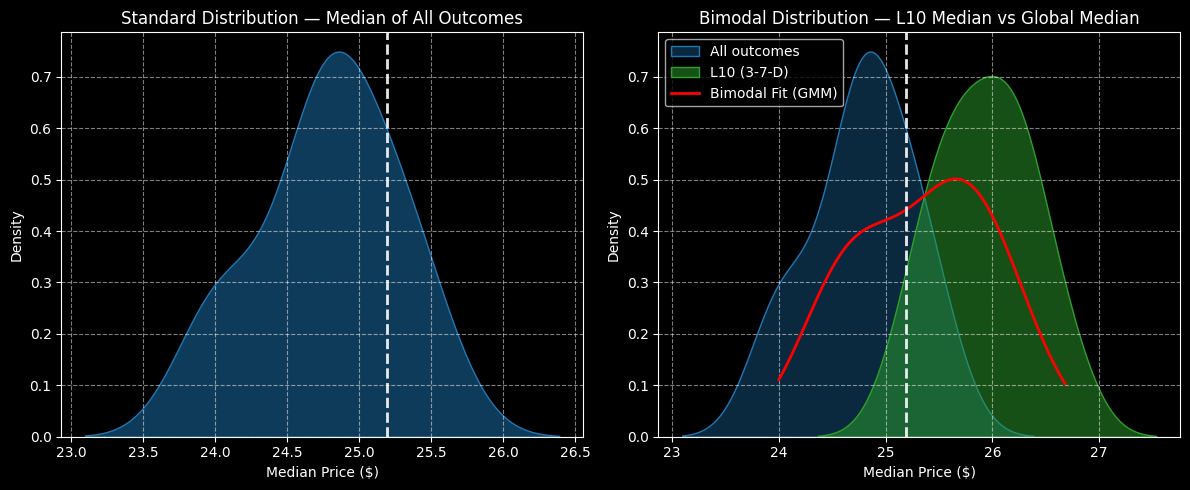
However, those who want to stretch out can consider the 25/27 bullish differentialwhich also expires on January 16. This trade would offer a payout of over 117% if the second strike is triggered, which is extremely ambitious but feasible.
Fastenal (FAST)
Fastenal (FAST), a supply chain solutions company, is a key player in the industrial and construction ecosystems. While FAST stock has gained nearly 11% since the beginning of the year, its recent results have not been encouraging. In the last month, it is down more than 6%. Since the beginning of September, the value has plummeted almost 21%.
Still, from a quantitative perspective, traders could soon have a reversal on their hands. Using the KM-KDE approach, the median 10-week returns for FAST stock would be expected to range between $39.30 and $41.50 (assuming an anchor of $39.91). Furthermore, the price grouping would likely materialize at around $40.75.
However, we are not so much interested in the aggregate data but in the current signal, where FAST shares are structured in a 3-7-D formation. Based on this sequence, 10-week forward yields would likely be between $39 and $44. Most importantly, the price grouping would likely occur at $41.85.
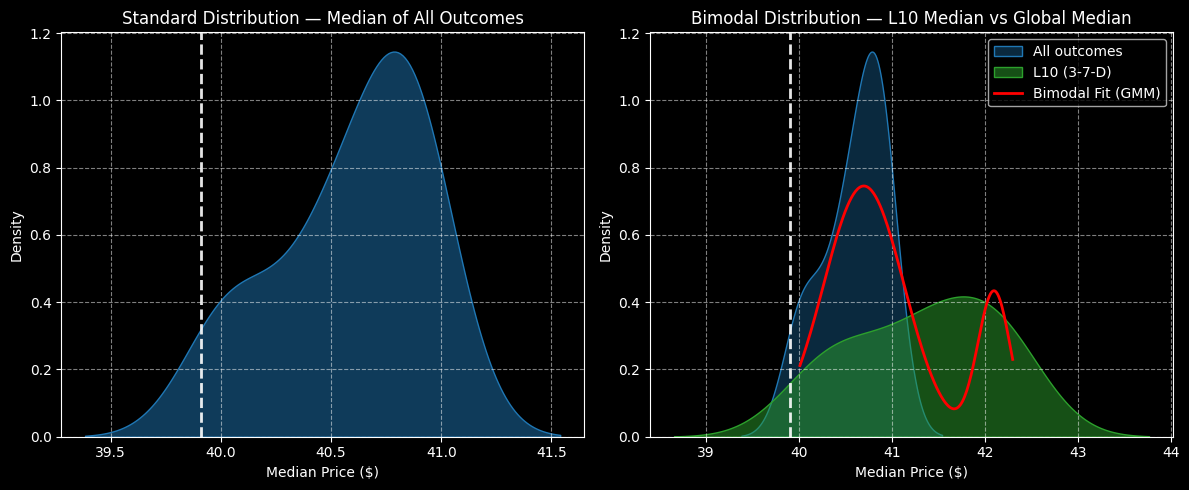
Aggressive traders may want to take a look at 40.00/42.50 bullish spread expires December 19. On the one hand, the upper leg movement is within the distribution curve of probable results. Secondly, the breakeven price of $40.95 makes this trade quite attractive to extreme speculators.
On the date of publication, Josh Enomoto had no (directly or indirectly) positions in any of the securities mentioned in this article. All information and data in this article are for informational purposes only. For more information, see Barchart’s Disclosure Policy here.
