

Markets have had problems this week as fears increase. Wall Street is nervous since investors say that mixed Trump administration signals about rolling tariffs are creating confusion instead of relieving concerns.
He has fell 4.3% since President Trump assumed the position on January 20, and tariffs are a great concern for investors. Many believe that tariffs could damage economic growth and drive at higher prices.
On Thursday, the shares faced a strong sale after Trump announced an exemption of one month for Canada and Mexico of the 25% rates they introduced at the beginning of the week. The Nasdaq fell 2.6% that day and has been in a correction since its record on December 16.
This last tariff movement gave limited relief to actions, since Wall Street is not sure of how a trade policy driven by the rate could affect the economy.
Now it has officially entered into corrective territory with losses of 10% since its maximum of all time.
Trump believes that tariffs can increase income, growth and help negotiations with other countries. However, investors are concerned that they can harm consumer confidence and make companies retain spending.
SOURCES: LSEG DATASREAM
A brief pause arrived on Friday with the launch of US data. UU. The United States added 151,000 jobs last month, according to the Labor Department, after a revised increase of 125,000 jobs in January. Economists had predicted an increase of 160,000 jobs, compared to the previous January 143,000 figure.
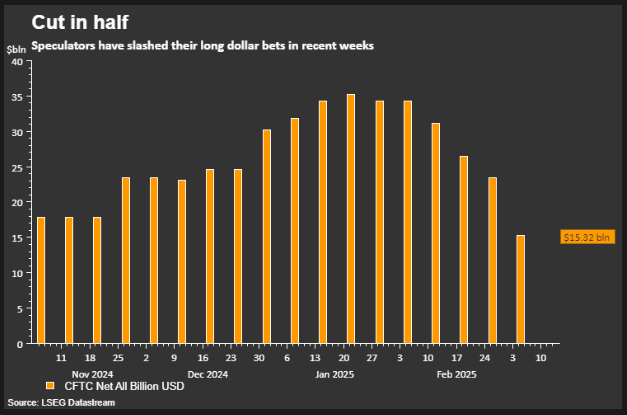
In the FX front, the FX showed its vulnerabilities and is ongoing during its worst week in more than a year. The dollar has fallen around 5% since President Trump took office in January and is now at a minimum of four months.
Concerns about the growth of the United States, fed by the news of the commercial rate, have harmed the dollar. Meanwhile, Germany’s impulse in spending has improved Europe’s economic perspective, leading investors to transfer their money to economies with stronger growth prospects.
The table below shows how speculators have reduced their bets for a US dollar in recent weeks.
Source: LSEG
In the front of the basic products, this week has been recovered to change over the $ 2900/OZ brand, but continues to fight to drill through the resistance in the handle of $ 2924. As we have discussed for weeks, the geopolitical situation together with the tariff uncertainty probably maintain the support of the precious metal.
Prices failed this week thanks to the announcement of the OPEC+ and the fears of growth.
Next week: tariffs at the forefront. Will Trump follow him?
Asia Pacific markets
The main approach this week in the Asia Pacific region for me is the two sessions of China and inflation data.
China’s two sessions end next Tuesday, with key updates of expected policies on stimuli and reforms. February inflation data is due to Sunday, and the impact of the lunar new year can carry consumer inflation to -0.3% year after year, while the producer’s inflation is also expected to be negative. Credit data is expected for February next week, with markets that predict greater general financing and new loans in RMB.
In Japan, I hope that the growth of work profits will slow down, mainly due to smaller bonus payments. The January inflation peak will probably push real profits to the negative. The GDP of the fourth quarter can be checked from 0.7% to 0.5% because capital spending was weaker than expected.
The markets still focus on Japan as the increases in additional interest rates of the Bank of Japan remain on the table.
Europe + United Kingdom + EE. UU.
In developed markets, the United States inflation is back in the attention center. However, the data can be seen once again by the Tit-For-Tat Rate Developments that will continue.
It is expected that inflation of the consumer price of the United States will remain high in the next week, with an increase of 0.3% month by month forecast. Commercial surveys show that some companies are increasing prices before possible tariffs. Food and energy costs are also pushing the highest inflation, although gasoline prices have recently decreased.
However, markets are currently more concerned with growth slowdown, government expenses and risk of reducing purchasing power if tariffs lead to higher prices. In the last three weeks, expectations have changed a small rate cut this year to three. It is unlikely that an inflation figure of 0.3% changes this perspective.
The EU and the United Kingdom have a little respite on the data front next week with a speech by the president of the ECB Christine Lagarde on Wednesday the highlight.
The Canada Bank has already reduced rates by 200 basic points due to weak growth and low inflation. American tariffs on Canadian imports are adding fears of a recession. Governor Macklem warned that a long commercial conflict could seriously damage the economy, which their models show that they would be reduced before recovering in a path 2.5% below the previous forecasts.
Since 76% of Canadian exports go to the United States, equal to 20% of GDP, risks are high. With 6.6% unemployment and 1.9% inflation, Boc can reduce rates by 25 other basic points on Wednesday.
Graph of the week
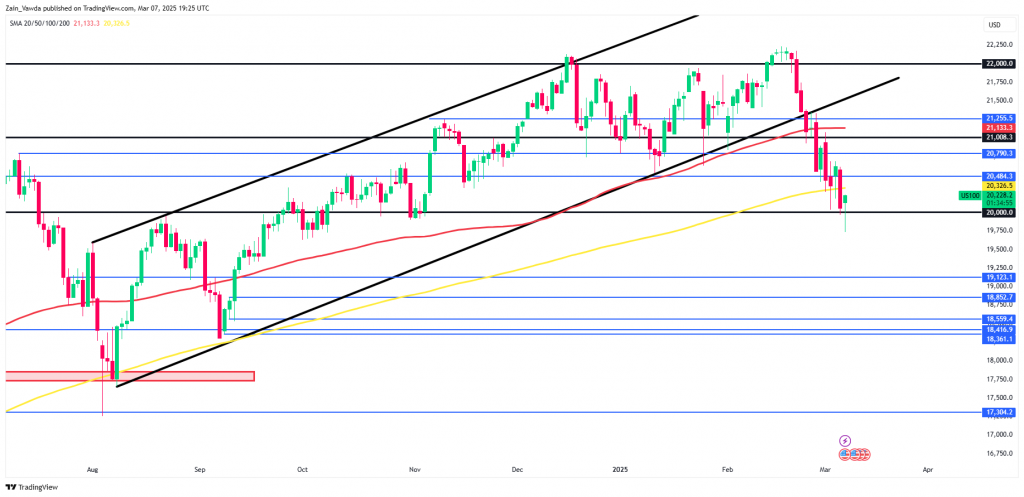
This week’s approach is in the Nasdaq 100 graph since the index had fallen up to 10% from its maximum of all time last week.
However, Friday brought a significant recovery of the weekly minimum of 19733, and the index increased to trade in 20131 at the time of writing. That is a 2% percent increase in weekly decline.
Is this a temporary setback or the bulls have finally returned?
Time will say it, but given the amount of uncertainty and concerns of companies, there is a real possibility that there may be more inconvenience ahead.
The immediate resistance rests on the 20326 handle that also houses the 200 -day MA and could be a difficult nut to break. If the index is able to record a daily candle, close above this level, then a race around 20484 and 20790 becomes a real possibility.
However, a rupture of the Psychological Mango could be key and could lead to a long -term outputs sale in mid -18000.
Support can be found in 19750 and 19123.
Nasdaq 100 Diario del Diario – March 7, 2025
Source: TrainingView.com (click to expand)
Key levels to consider:
Support
Endurance
Original publication
!function(f,b,e,v,n,t,s){if(f.fbq)return;n=f.fbq=function(){n.callMethod? n.callMethod.apply(n,arguments):n.queue.push(arguments)};if(!f._fbq)f._fbq=n;n.push=n;n.loaded=!0;n.version=’2.0′;n.queue=[];t=b.createElement(e);t.async=!0;t.src=v;s=b.getElementsByTagName(e)[0];s.parentNode.insertBefore(t,s)}(window, document,’script’,’
Source Link
